
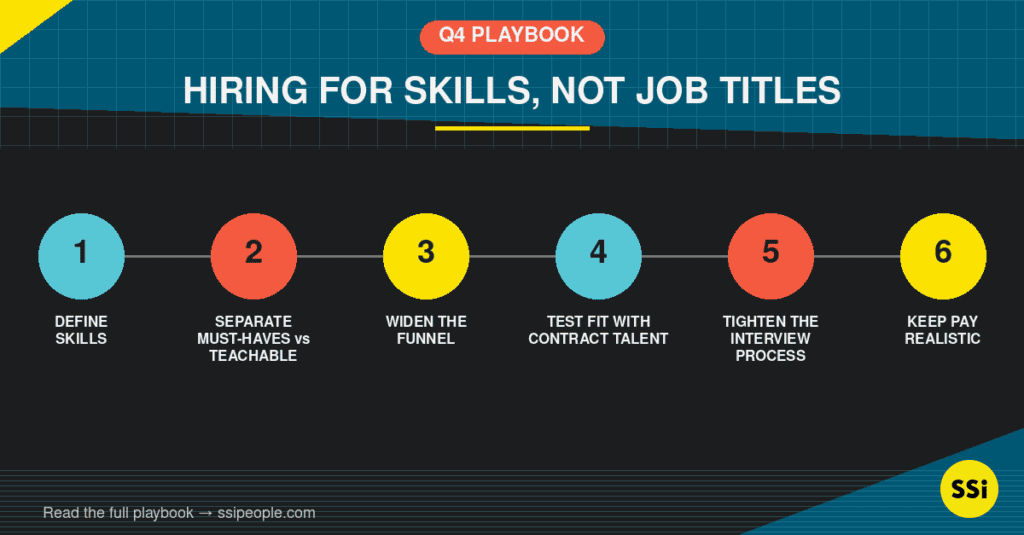
Quick Answer: In a market where hiring is cautious and roles are changing, the strongest Q4 hiring plans start with the work to be done, not the job title. Audit the role, separate must-have skills from teachable ones, widen your talent pool, test fit with flexible models, tighten your interview process, and keep pay in line with the market.
Hiring today is a balancing act. The U.S. added 162,000 jobs in August, unemployment held at 4.1%, and average hourly earnings rose 3.1% over the year (BLS). On September 16, the Federal Reserve raised rates a quarter point to 3.75%–4.00%, with inflation still above target and one more hike projected this year. Meanwhile, the July JOLTS report showed 7.3 million open jobs but only 5.1 million hires.
In other words, budgets are under a microscope, every hire is scrutinized, and the roles you’re filling may look different from the ones you filled two years ago. Here’s what’s driving Q4 hiring, and a six-step playbook for hiring on skills instead of titles.
What’s driving hiring decisions right now
ManpowerGroup’s Q4 2026 survey found that 43% of U.S. employers plan to add staff and 14% plan to reduce it. Among employers who are expanding, 62% say the reason is changing roles and skills, not just growth. Despite the buzz around AI in recruiting, timelines haven’t improved much: only 28% of employers say hiring is faster than in 2025, 41% see no change, and 30% say it’s slower.
Staffing data points the same way. Bullhorn’s August report shows permanent job orders about 11% above August 2025, with demand concentrating in sectors tied to infrastructure and AI data center buildout. Employers are prioritizing analytical thinking and leadership, and compensation is rising fastest in construction, engineering, and warehouse roles.
A six-step playbook for hiring on skills, not titles
1. Audit the work, not the title
Start with outcomes. What should this person deliver in their first six to twelve months? Rewrite the job description around that work and drop legacy requirements that no longer apply. If the role has shifted because of new tools, systems, or AI, the description should say so.
2. Separate must-have skills from teachable ones
Long wish lists lengthen searches. Choose the three to five skills that are truly non-negotiable, and decide which others can be learned in the first 90 days. Given that employers are prioritizing analytical thinking and leadership, look for evidence of those in how candidates have solved problems, not only in the titles they’ve held.
3. Widen the funnel
ManpowerGroup found that 45% of employers plan to add early-career talent, while just 20% plan to cut it. Consider candidates with adjacent skills, career changers, and early-career professionals paired with senior mentors. A wider pool is one of the fastest ways to shorten time-to-fill without lowering the bar.
4. Test fit with contract or contract-to-hire
When rates are rising and budgets are cautious, flexibility has real value. Contract and contract-to-hire arrangements let you add capacity for a specific project, or evaluate fit on both sides before committing to a permanent hire. The American Staffing Association reports nearly 2.2 million temporary and contract employees worked for U.S. staffing companies in an average week in 2024, so this is a well-established way to staff.
5. Tighten your interview loop
If AI hasn’t made hiring faster for most employers, the bottleneck is usually process. Our recommendation: keep to a defined number of interview rounds, name the decision-maker up front, and give candidates feedback within a couple of business days. Strong candidates rarely wait around, and a slow process can cost you the person you want.
6. Keep pay realistic
With average hourly earnings up 3.1% year over year, and Bullhorn reporting the fastest compensation growth in construction, engineering, and warehouse roles, offers based on last year’s numbers can stall a search. Benchmark before you post, and be ready to explain the full value of the role, including work style, growth path, and project scope.
How SSi People can help
SSi People has spent more than 25 years staffing IT, engineering, professional services, and clinical roles for Fortune 1000 clients. We give honest assessments without overselling, and we set consultants up to actually succeed in the role, not just show up on day one. Whether you need a specialist for a critical project or a long-term hire, let’s talk: ssipeople.com.