

In today’s increasingly digital and global hiring landscape, candidate impersonation fraud has evolved into a sophisticated and organized threat. In our staffing firm, not having a solution in place can amplify how deeply disruptive and damaging these schemes can be, demonstrating that a reactive posture is no longer sufficient. Instead, as a top staffing partner, we are prioritizing prevention, early detection, and reputational defense. Here’s how we’re stepping up.
The Rising Threat of Employment Fraud
Employment fraud, particularly impersonation schemes, are escalating. These include scenarios where overseas syndicates facilitate identity theft, enabling impostors to secure real jobs, start work, and collect paychecks—all before detection.
- According to Nisos, employment fraud now falls into three categories:
- Misrepresentation—fraudulent resumes or falsified references
- Polywork—candidates outsource work to unauthorized third parties
- Organized fraud—high-risk schemes involving criminal or state‑linked networks
- Vertriax reports companies typically lose an average of 5% of annual revenue to fraud, which often remains hidden for 18 months; and warns that by 2028, 1 in 4 candidates may be fake.
- Across the U.S., job‑related scams surged: the FTC reported 105,000 incidents in 2024, up from 38,000 in 2020, with consumer losses rising from $90M to $501M according to the Washington Post.
These data points highlight how organized and consequential this threat has become.
Types of Recruitment Fraud Impacting Businesses
Staffing firms and employers now face a broader spectrum of impersonation and identity‑fraud schemes:
- Fake identity hires: imposters assume identities, get placed, and begin work—sometimes for months—before fraud is uncovered. These are typically well‑coordinated operations.
- A stark example reported on was the story of Christina Chapman, a U.S. based facilitator, who operated a large-scale North Korean IT fraud ring. She helped imposters, posing as U.S. citizens with stolen identities, obtain remote roles at Fortune 500 firms. The scheme, which ran from 2020 to 2023 and involved “laptop farms,” stole numerous identities, and funneled approximately $17 million to North Korea before law enforcement intervened.
- Digital candidate impersonation: fraudsters use fake credentials, backgrounds, and histories to clear initial screening, often leveraging remote interviews or AI-altered personas to bypass traditional hiring screenings.
- Experts further note the use of AI tools, deep fakes, and VPNs by imposters to deceive hiring processes and evade background checks, continues to grow as a serious threat to hiring integrity.
- Resume and application fraud: false or exaggerated resumes, often AI‑generated, mislead hiring teams about experience, qualifications, or capability.
- NPAworldwide reports that AI has transformed résumé fraud into an epidemic. Furthermore, AI is increasingly being used to craft misleading or entirely fictional resumes. One survey showed that up to 80% of hiring managers discard applications identified as AI-generated due to authenticity concerns.
- Employment scams disguised as job offers: Not only are HR and companies being scammed but job seekers are as well. The Federal Trade Commission warns that scammers are impersonating recruiters and/or well-known companies to extract personal data and/or fee payments from job seekers. They are even targeting staffing clients indirectly.
- SSi offers some tips for job seekers to avoid recruitment scams.
Early Red Flags & Risk Indicators
Leading analysts identify warning signals across hiring and onboarding workflows. Here are some warning signs from Nisos:
- Suspicious applicant behaviors:
- Use of generic or fabricated email addresses or shipping addresses mismatched to I‑9 data.
- Minimal or artificial online presence, reused photos, or accounts created solely around employment sites.
- Reluctance for video or in-person interviews, especially when remote-first roles are involved.
- Underperformance inconsistent with claimed credentials.
- Organizational risks: inability to verify references, shipping equipment to suspicious addresses, or unusual account activity may signal deeper fraud.
Staffing firms are actively aware of these telltale signs, as they often provide the first trace of a fraud operation.
Proactive Measures That SSi Embraces
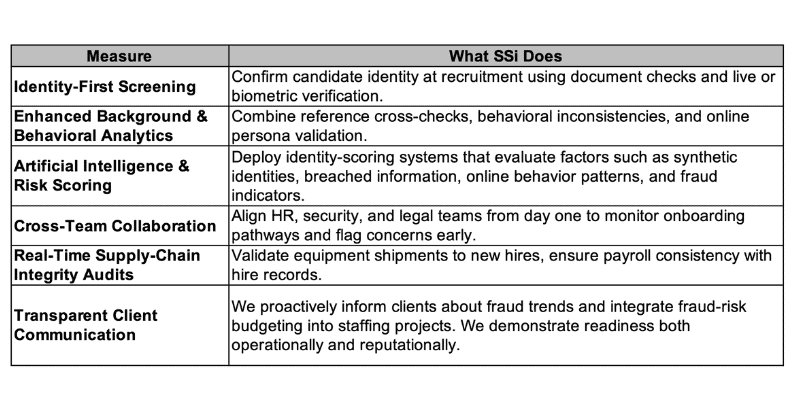
At SSi, our People Care Center in addition to creating a seamless and turnkey experience for our valued consultants, has adopted an integrated and layered fraud defense strategies to stay ahead:
Why Clients Should Demand This Level of Vigilance
Partnering with a staffing firm like SSi, one that treats fraud detection as foundational rather than optional, brings essential value:
- Brand protection: A single imposter, uncovered late, can damage both the contracting organization and the staffing provider.
- Operational resilience: Early detection avoids unnecessary downtime, legal exposure, and financial loss.
- Cost-effective risk management: Investing in fraud prevention upfront is far less costly than remediation and crisis response.
- Competitive advantage: Clients feel more secure and confident working with partners invested in integrity and trust.
Leading with Preventive Action
Employment fraud is no longer a marginal concern. Sophisticated, often cross-border impersonation rings are bypassing traditional hiring safeguards. At SSi, we’ve recognized this evolution and responded accordingly, embedding robust identity-validation, behavioral analytics, legal-security integration, and audit frameworks into our approach.
To our existing clients, and to organizations seeking strategic staffing partners, let us be clear: We go on the offensive. Proactive fraud defense is not optional—it’s essential. Aligning with a staffing partner that delivers both talent and trust ensures reputational and operational safety in today’s high-risk hiring environment.